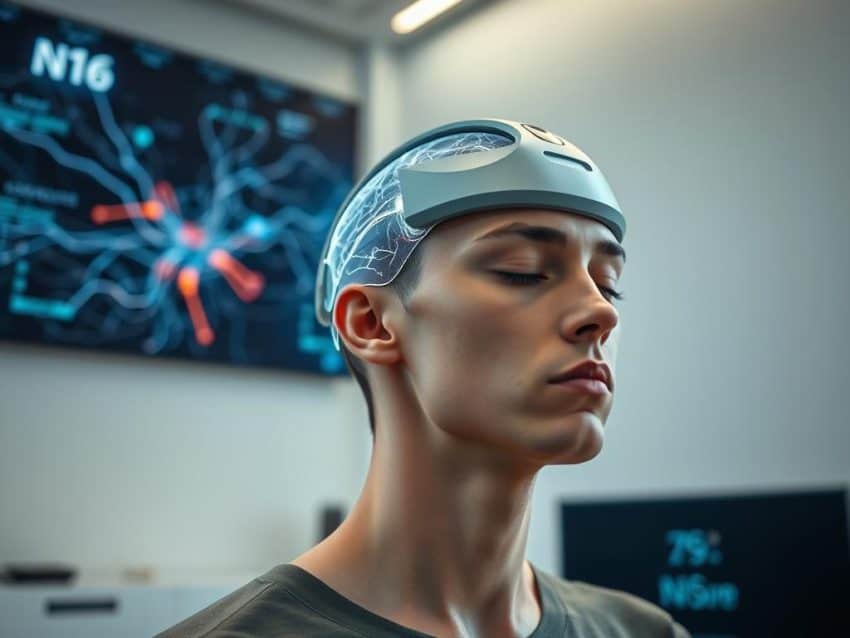
Did you know over 20 percent of adults in the U.S. have a neurological disorder? This shows how brain-computer interfaces (BCIs) could change technology and lives. BCIs let people control devices with their minds, changing tech forever.
Companies like Neuralink and Synchron are leading this change. They help people with severe disabilities control technology again. As we explore more in neuroscience and AI, BCIs are set to change how we interact with machines.
Key Takeaways
- BCIs allow for direct brain access to control external devices.
- Innovations from Neuralink and Synchron are leading the way in BCI development.
- Applications range from medical rehabilitation to enriching human capabilities.
- Ongoing research is vital for tackling ethical and operational issues.
- BCIs have the power to transform human-AI interaction significantly.
Understanding Brain-Computer Interfaces and Their Applications
Brain-computer interfaces, or BCIs, are new tech that lets our brains talk to devices. They come in two types: non-invasive and invasive. Non-invasive BCIs use sensors on the scalp to read brain signals. Invasive BCIs have electrodes implanted to get clearer signals.
These techs change how we interact with the world. They’re used in many fields, making a big impact.
What is a Brain-Computer Interface?
A brain-computer interface lets us talk to computers with our minds. It uses brain signals to do this. These signals are picked up by methods like EEG or MEG.
Non-invasive BCIs, like EEG, are safe and easy to use. They read brain waves linked to our thoughts or actions. This lets us control things just by thinking.
Applications Across Various Sectors
BCIs are used in many areas, like healthcare, entertainment, and education. In healthcare, they help people with mobility issues. They can control prosthetics or communicate through devices.
In gaming and virtual reality, BCIs make experiences better. Players can control things with their minds. Neuroscience keeps finding new ways BCIs can help us.
How Brain-Computer Interfaces Are Empowering Users
Brain-computer interfaces are changing how we see and improve human abilities. I’m excited about the big changes in neurotechnology. These advancements help people move again and open new doors with robotics.
From the Utah array in 1989 to today’s Layer 7 Cortical Interface, progress is fast. These systems now have more electrodes, showing how far we’ve come.
Enhancing Human Capabilities
People with paralysis or amputations are getting better thanks to neurotechnology. Devices like Neuralink’s N1 chip connect with over 1,000 brain cells. This lets paralyzed people move again and helps with diseases like Alzheimer’s and Parkinson’s.
AI can even read brain signals to see if someone is stressed or relaxed. This lets users understand their minds better.
Recent Technological Advancements
The BCI market is expected to jump from $1.7 billion in 2022 to $6.2 billion by 2030. This shows how much people want in robotics and neurotechnology. New methods like near-infrared spectroscopy can read brain signals without implants.
Studies show we can turn brain signals into images and music. But, we must think about privacy and getting people’s okay as these techs grow.
Conclusion
Looking at brain-computer interfaces (BCIs), we see a big change coming. These technologies are changing how we interact with machines and each other. They have a bright future in healthcare, communication, and entertainment.
BCIs can help people with movement disorders and improve thinking skills. This shows how they can make life better for many people.
But, there are also big ethical questions to answer. We need to think about who owns data and how it’s used. There’s also the worry that people might lose access to these technologies because of money issues.
To move forward with BCIs the right way, we need to work together. Policymakers, developers, and healthcare experts must join forces. We must protect patient data and keep devices working well.
By working together, we can make sure BCIs are both innovative and ethical. As these technologies grow, we must balance their benefits with our ethical duties. This is key in this exciting field.
